



You have done the questions. Hundreds of them. You have sat the mock tests, watched the videos and learned the tips. And your PTE score is not improving.
That does not mean you are lazy. It does not mean practice is useless either. Practice works. It taught you the screens, the timing and what each task wants. What stalls is practice without a diagnosis. A score tells you where you are. It does not tell you why. Until something names the habit that keeps costing you marks, every new question is the same answer again.
Here is why a PTE score gets stuck, the six reasons we see most often, and what to do about each one. Most of it needs no app at all.
Why more questions stop moving the score
Your score is built from marks on specific things. It is not built from effort.
Every answer is marked on named traits. In Pearson's Score Guide for test takers, a spoken answer such as Describe Image is marked on Content, Pronunciation and Oral Fluency. In Read Aloud, each word you replace, skip or add counts as one error against your Content score. The Oral Fluency bands read almost like a count. The top band has no hesitations, repetitions or false starts. Each band below it allows a few more.
So the test does not know how many questions you did this week. It only knows how many hesitations, skipped words and missing ideas were in your answers on test day. If those counts do not change, the score does not change.
This is also why the first weeks feel so good. Pearson says a score can improve "within a relatively short period, even if your underlying proficiency has not changed dramatically", simply because you now understand the format and the scoring. You learn the test, and the number jumps. Then it goes flat. The easy gains have run out. What is left is a small set of habits you cannot hear in yourself, and a few scoring rules nobody told you.
More questions repeat those habits. They do not remove them. If you restart a sentence every time you stumble, fifty more Read Alouds are fifty more rehearsals of restarting. Pearson says it in the same article: "the biggest gains usually come from using your time more precisely, not from spending more hours studying."
Six reasons a PTE score stays stuck
Read these as a checklist. You will not have all six.
1. You practise questions, not mistakes
You do dozens of questions a day and check only the score. The same two or three habits sit inside most of your answers: a pause before numbers, a restart after a stumble, a missing plural in Write from Dictation. Nobody counts them, so they never change.
What to do instead
- After each answer, name the one thing that cost you most. One, not five.
- Keep a simple tally: the task, what went wrong, how many times this week.
- Practise only that, on new questions, until the tally stops growing. Then pick the next one.
2. A memorised line can make the whole answer zero
Many students learn a template full of fixed sentences and say it on every Describe Image and Retell Lecture. Then they practise fluency for weeks and Speaking does not move, because the fluency was never counted.
The Score Guide says that pre-prepared or memorised material is treated as irrelevant to the question. If Content scores zero, nothing else in that answer is scored. Pearson's speaking tips even give an example of the kind of line it means: "The image is of a beautiful graph and shows various information". And for tests taken after 7 August 2025, a human expert also reviews the Content of seven task types, including Describe Image, Retell Lecture and Write Essay (Pearson's 2025 changes).
A structure is not banned. Pearson's rule is about large amounts of memorised material, not about having an order to follow. Pearson has not published how it spots a memorised answer, so be careful with anyone who claims to know.
What to do instead
- Use a frame for the order, never a script of sentences. A frame says what comes first: what the picture is, the biggest thing, a comparison, a conclusion. The words inside it must be this question's own facts, numbers and names.
- Test every sentence with one question: would it make sense for a different picture or lecture? If yes, cut it.
3. You train speed, but the test counts fluency
"Speak fast to get fluency" is the most common myth in PTE. You rush, you trip, you restart, you add fillers. Every restart is a false start or a repetition on the fluency scale.
Pearson's own Repeat Sentence advice is the opposite: "Speaking too quickly will reduce your score, as you will not be speaking with natural fluency". The same tips say not to correct yourself or start again after a mistake. And Pearson is clear about accents: "We judge your English skills, not your accent".
What to do instead
- Speak in short groups of words at your normal pace, the way you talk on the phone.
- When you slip, keep going. A smooth answer with one wrong word usually costs less than a stop and a restart. "Usually", because Pearson does not publish the exact formula.
- Record yourself, listen once, and count your restarts and long pauses. Bring that count down. Do not try to go faster.
4. You practise for the wrong skill
"My Writing is stuck, so I write an essay every day." Write Essay is one question in the test.
Many of the 22 task types count towards two skills at once. And your overall score is not an average of the four skill scores. In the current Score Guide:
- Writing is fed by Summarize Written Text, Write Essay, Summarize Spoken Text and Write from Dictation. Write from Dictation appears three or four times in a test. The essay appears once.
- Repeat Sentence has ten to twelve questions and counts for both Listening and Speaking.
- Read Aloud counts for Speaking only. A lot of older advice says otherwise.
- Answer Short Question is spoken, but it scores Listening.
What to do instead
Start from the skill you are short in. List every task that feeds it. Give your time first to the tasks that feed that skill and appear many times in a test, then to the rest.
5. You lose marks on rules you could learn in one evening
Some marks have nothing to do with your English. They go to rules.
- In Multiple Choice, Multiple Answers, each correct option is plus one and each wrong option is minus one. Ticking every option does not help. Highlight Incorrect Words has the same minus for each wrong click.
- In the reading Fill in the Blanks tasks there is no minus, so never leave a blank empty.
- Summarize Written Text asks for one single sentence. Two sentences lose the Form mark.
- The essay's full Form mark is for 200 to 300 words. An essay under 120 words scores zero for Form.
- In Answer Short Question, the microphone closes after three seconds of silence, so do not think too long.
What to do instead
Learn each task's scoring rule once, before you grind it. Then guess sensibly where there is no minus, and choose only what you are sure of where there is one.
6. You sit mock after mock
A mock test measures. It does not teach. If you sit one, look at the number, feel good or bad, and sit another, nothing between the two has changed.
The number also wobbles. Even the real test has a measurement error, and Pearson publishes it in its Score Guide for institutions. Its own example: with an error of 3, a reported 60 means the true score is between 57 and 63, with 68 per cent certainty. If the real test moves that much, a practice mock that went up two or three points has told you very little.
What to do instead
- Use a mock as a checkpoint, not as practice.
- Before the next one, review every answer that lost points, and practise those mistakes on fresh questions.
- Do not read two or three points as a trend. Check whether the same mistakes are still there.
A 20-minute check you can run tonight
You do not need any tool for this. You need three recordings and a pen.
- Pick one speaking task. Read Aloud is the easiest to check.
- Record three answers on your phone, one after the other, under test timing.
- Listen to each one once. Do not judge your accent. Count three things only: restarts, long pauses, and words you skipped or changed.
- Write down the one thing that shows up in all three recordings.
That one thing is your diagnosis. Now your next questions have a job.
What to do instead: one mistake at a time
A week that breaks a plateau is simple on purpose. Pick the one mistake that cost the most. Do short daily sets on it, on new questions, under test conditions. Count it again at the end of the week. When the count has dropped, pick the next one.
This is the loop we built Learniiz around: find it, fix it, prove it. Here is where the app does that work for you, and where it does not.
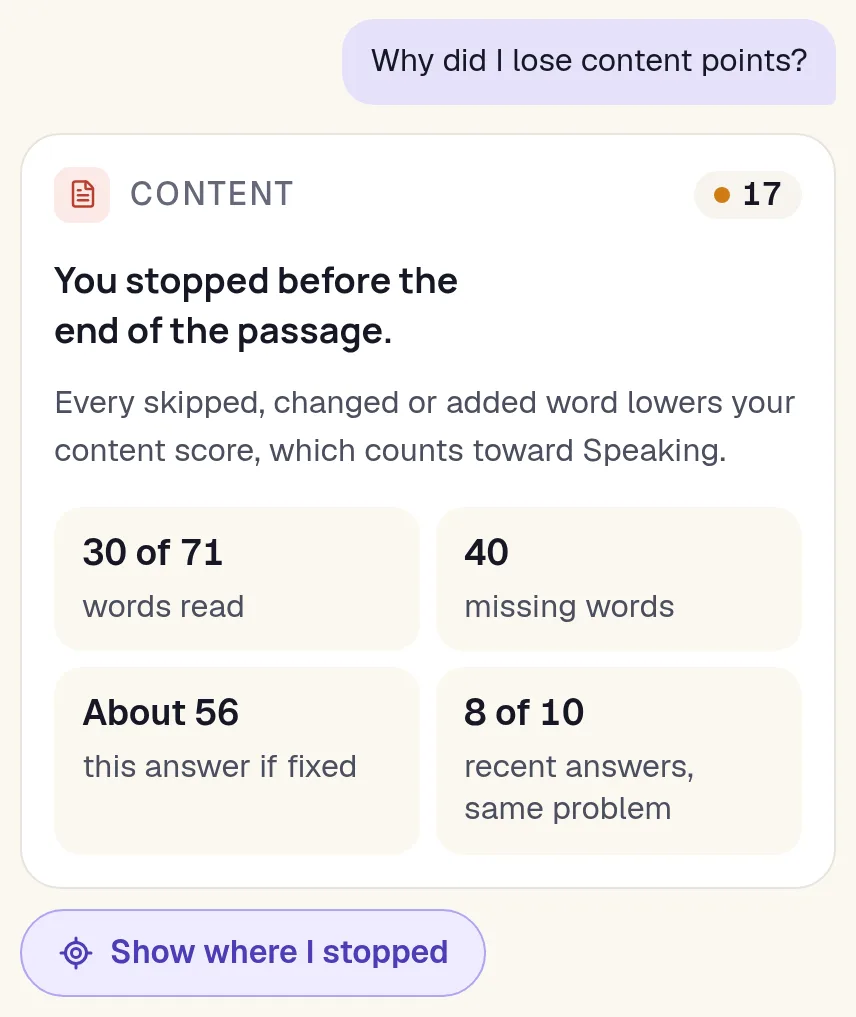
It names one fix first. After a spoken answer, Nizi, the tutor inside Learniiz, shows your estimate and then the single biggest problem. You can hear the exact moment in your own recording, and see how many of your recent answers had the same problem.
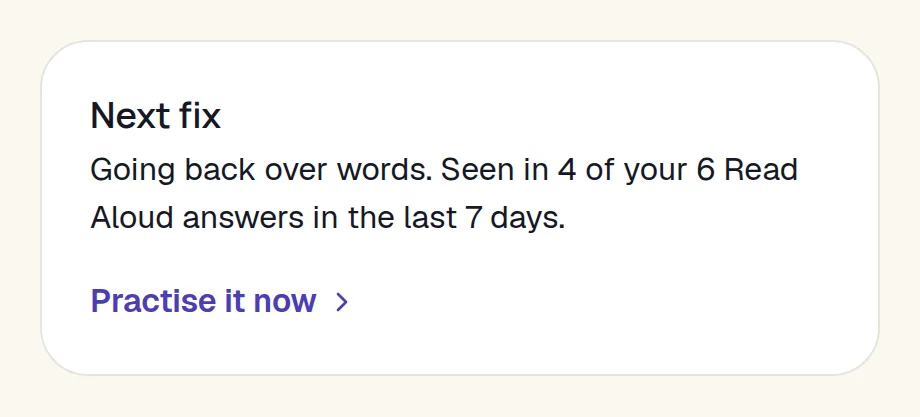
It keeps the tally. Learniiz counts the same mistake across your answers from the last seven days. Once a mistake has shown up in at least two answers, you get one Next fix, with one button to practise it.
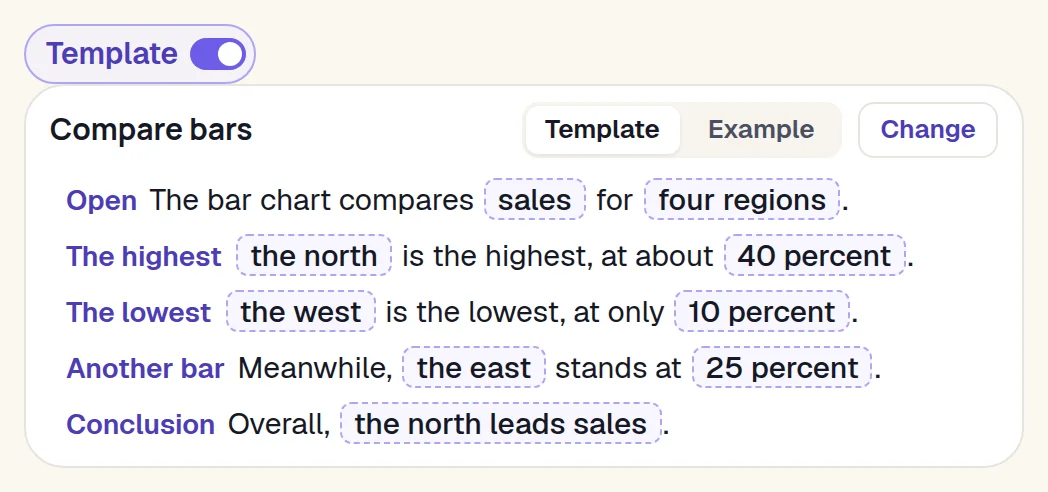
Its templates are frames, not scripts. On tasks such as Describe Image, Retell Lecture and Write Essay, the Template gives you an order to follow, and its gaps are filled with this question's own details. Guide me also walks you through a task before the timed try, and on many tasks it tells you the scoring rule first.
Its section tests follow the skills. Each one holds every task type that feeds that skill, so Repeat Sentence sits in both the Speaking test and the Listening test.
Its mock report is a review, not just a number. Every answer shows its trait marks, why it lost points, how to fix it, and a way to practise that same question again. Wrong answers on the reading and listening tasks that are simply right or wrong also come back for review after 1, 3, 7 and 14 days.
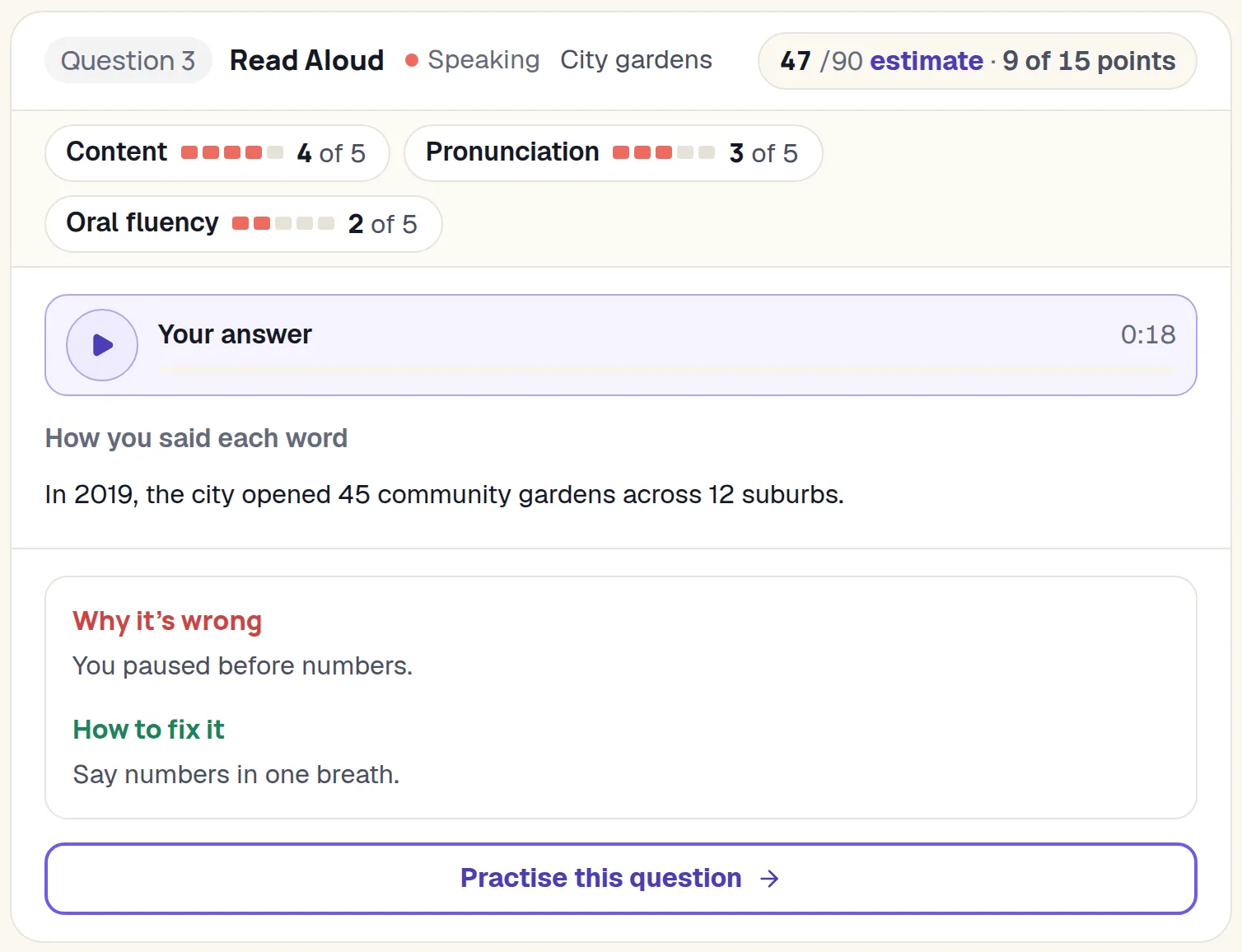
What Learniiz does not do: it does not issue official scores. Only Pearson does. Every number in Learniiz is a practice estimate.
Two more honest limits. When Learniiz says an answer sounded learned, that is its own judgement, not Pearson's check. And speaking and writing mistakes do not come back on a schedule yet. They come back through the Next fix count.
How long should a real improvement take?
Pearson gives its own rough pace for consistent practice in the same article: 5 to 10 points in about 4 to 6 weeks, 11 to 20 points in 2 to 3 months, and 20 or more in 4 to 6 months or longer.
Those are Pearson's estimates, not a promise from Pearson and not one from us. Use them to check your plan. If the gap to your target is bigger than the time before your test, Pearson itself says you may need to adjust your target or your timeline. Better to know that now than after another test fee.
Before you book the next test
Run through this list first.
- Can you name the one mistake that cost you most last time?
- Has its count gone down on new questions, not on questions you have seen before?
- Do you know the scoring rule for every task that feeds your weakest skill?
- Does your timeline fit Pearson's own pace for the points you need?
If the first two are a no, more questions will not change your next result. Fix those first.
Questions people ask
Why is my PTE score stuck at the same number?
Usually the easy gains from learning the format have run out, and the marks you still lose come from a few repeated habits and scoring rules. Find the one that costs you most and work on it alone.
My PTE score is not increasing after several attempts. Should I just take more mock tests?
No. A mock tells you where you are. It changes nothing by itself. Review every answer that lost points, practise those mistakes on new questions, and only then sit another.
Do templates still work in PTE?
A structure is fine. Memorised sentences are the risk: Pearson treats large amounts of memorised material as irrelevant, and a Content score of zero means the answer earns nothing. Build each sentence from the question in front of you.
Should I speak faster to improve oral fluency?
No. Pearson says speaking too quickly will reduce your score. Fluency means few hesitations, repetitions and restarts. Speak at your normal pace and keep going when you slip.
← All posts